
The short answer
BPC-157 is being investigated for tissue-repair effects, including tendon and muscle recovery. Its most persuasive findings so far come from experimental models; the available human studies do not establish how reliably it improves recovery from a particular injury. The useful question is which benefit was measured, in which setting, and how closely that setting matches the claim you are reading.
At a glance
- BPC-157 has a substantial experimental recovery literature, while human injury outcomes remain much less certain.
- A promising biological mechanism and a measured improvement in a patient answer different questions.
- Product identity, the condition studied and the outcome measured determine how relevant a claim is.
In this article
- What is BPC-157, and why is it studied for recovery?
- The main BPC-157 benefits people ask about
- What laboratory mechanisms tell us
- What do the human studies actually show?
- How to judge recovery results and before-and-after stories
- Product quality and the current US status
- Where BPC-157 fits beside TB-500 and the Wolverine stack
- Common questions
A person hoping to walk comfortably after a knee problem, a runner recovering from a hamstring strain and a lifter trying to regain tendon loading capacity have different goals. A page that puts all three under “healing” can make the evidence appear more complete than it is. This guide separates the main proposed benefits, shows where direct human observations exist, and explains what would make the next study more convincing.
What is BPC-157, and why is it studied for recovery?
BPC-157 is a synthetic 15-amino-acid peptide. Early research explored tissue protection and repair, and several experimental programs subsequently examined injured tendons and muscles. A rat Achilles-tendon study reported improved healing measurements; a separate rat quadriceps study examined structural and functional recovery after a surgically created injury. These studies help explain the interest in the compound, while remaining specific to their animal models. [1] [2]
The bridge from that research to a useful treatment is a sequence of questions. Does an effect occur in people? Does it improve an outcome they care about? Is it better than an appropriate comparison? Is the improvement large enough to justify the risks, cost and effort? Those questions cannot be answered by the number of promising laboratory findings alone.
For readers, the practical advantage of this distinction is precision. Instead of asking whether BPC-157 “works,” ask whether a particular formulation has been shown to improve a particular outcome in a comparable group of people. That makes a broad claim easier to investigate and harder to overinterpret.
The main BPC-157 benefits people ask about
The table below separates common recovery goals from the evidence needed to support them. It is an editorial map of the questions, rather than a ranking of expected results.
| Recovery goal | What would be meaningful | How to read the research |
|---|---|---|
| Tendon recovery | Restored loading capacity, function and durable activity | Animal tendon findings support investigation, not a predicted human recovery time. [1] |
| Muscle recovery | Strength, movement, reinjury rate and unrestricted activity | Experimental muscle findings need confirmation in relevant human injuries. [2] |
| Knee discomfort | A meaningful change in pain and everyday function | A small human report provides preliminary observations without a controlled comparison. [4] |
| Return to sport | A clearly defined return date and recurrence follow-up | A registered hamstring trial investigates this question; registration provides no treatment result. [6] |
A benefit can matter even when it is modest, but the article or study must say what changed. “Better recovery” is too broad to tell you whether the person had less pain, more strength, improved imaging or greater confidence. Those outcomes may be related, yet they should be reported separately.
Notice the difference between an outcome and an explanation. A statement about a repair pathway explains why scientists might test a compound. A controlled improvement in function explains whether the intervention helped the people studied. A good benefit claim tells you which kind of information it is presenting.
What laboratory mechanisms tell us
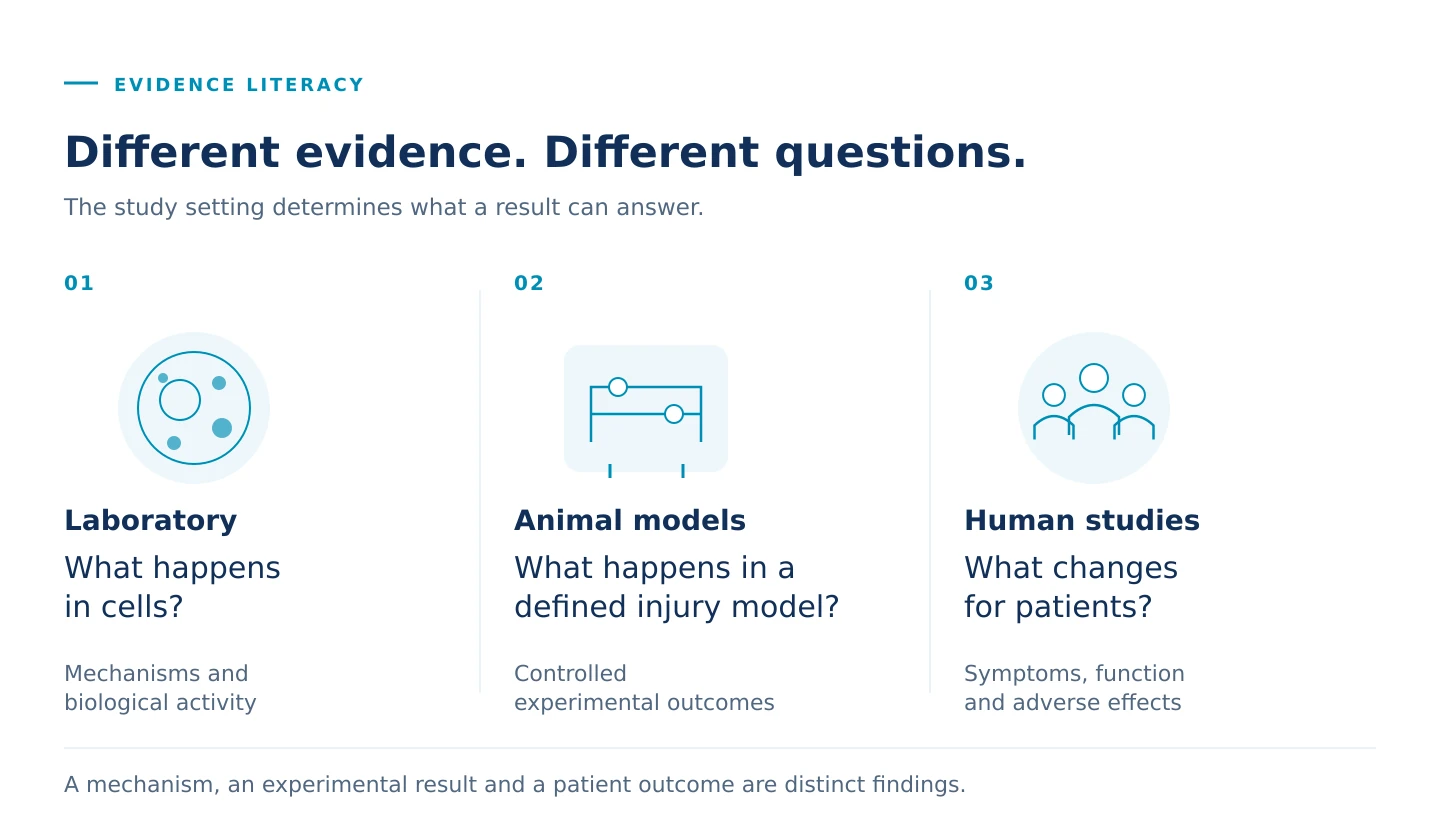
One tendon study examined rat-derived fibroblasts and tendon explants. BPC-157 was associated with greater cell migration, explant outgrowth and cell survival under experimental stress. Another investigated growth-hormone-receptor expression in rat tendon cells. These are specific laboratory observations, not evidence that BPC-157 raises growth hormone in users or produces a predictable muscle-building effect. [3] [8]
Mechanism language becomes useful when it connects to a testable clinical question. If an intervention affects a cell behavior relevant to repair, a next step might be to measure tissue function, symptoms and safety in an appropriately designed study. The mechanism should lead to that investigation, rather than replace it.
It also helps to ask how far the explanation has traveled. A result in isolated cells has been removed from many features of a living person. An animal injury model adds biological complexity, but still differs from a person with a longstanding problem, other conditions or concurrent rehabilitation. Each step can add information; each introduces a new question about whether the earlier finding applies.
What do the human studies actually show?
A 2021 retrospective knee-pain report contacted 16 people. Eleven of 12 who received BPC-157 alone reported improvement; the study had no control group and did not use validated tools to measure function. That makes it a preliminary signal, not a reliable estimate of success for a new patient. [4]
A separate 2025 intravenous safety pilot included only two adults and reported no adverse effects during its brief observation period. A study that small cannot characterize uncommon harms or establish long-term safety. It also did not test recovery from a sports injury. [5]
A registered hamstring-injury trial is recruiting participants. ClinicalTrials.gov record NCT07437547 describes a randomized, placebo-controlled study with rehabilitation in both groups and functional and imaging outcomes. Treat the registry as a description of the research question until completed results can be assessed. [6]
For the reader, the priority is understanding the comparison behind a percentage. If everyone receiving an intervention reports how they feel later, the result does not separate the intervention from other changes over that period. A comparison group and consistent outcome measurement make the interpretation more useful.
How to judge recovery results and before-and-after stories
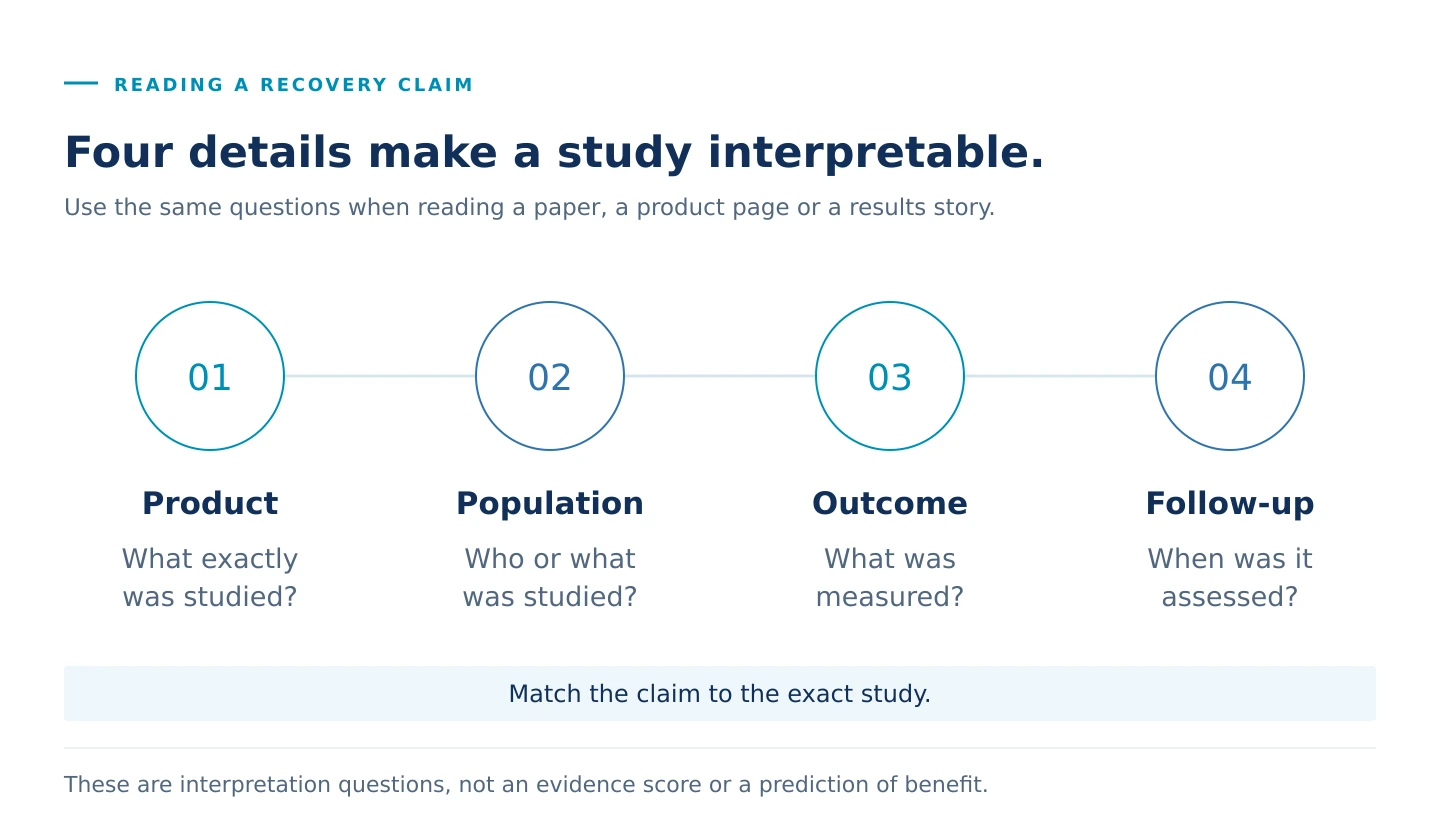
Start with the outcome you want the story to demonstrate. A pain score addresses discomfort. A strength test addresses a particular performance measure. An imaging finding addresses a structural observation. A successful return to a chosen activity addresses a real-world goal. None should quietly stand in for all the others.
Then look for missing context. What was the diagnosis? What happened before the intervention? Was the same outcome measured the same way afterward? Did the person also change training, rehabilitation or other treatment? How long did the improvement last? These questions improve the usefulness of a story without requiring you to dismiss the person’s experience.
A good progress report states the starting point, the actual change and the observation period. It records what did not change. If a testimonial only says “I felt amazing,” it may be meaningful to its author but gives another reader little basis for predicting an outcome.
For the same reason, a week-by-week benefit timetable should be supported by study results for the relevant use. A neat graphic is not evidence for a guaranteed sequence of improvement. The most informative timeline shows when researchers made measurements and what they found, with uncertainty visible.
Product quality and the current US status
Product identity deserves attention before any benefit discussion. FDA’s 2026 BPC-157 review describes different salts and related substances being sold under a common name. Its clinical assessment also highlights the small, short and incompletely reported human safety record. A label and the actual material therefore need to be matched carefully. [7]
In October 2026, HHS published a draft, nonbinding interim compounding policy covering specified peptides, including BPC-157. It does not make compounded products FDA-approved. The published policy sets conditions involving the ingredient, sourcing, testing and a patient-specific prescription. [9] [10]
When reading product documents, separate three questions: does the material have the claimed identity, does the finished product meet relevant quality requirements, and is there evidence for the proposed clinical benefit? A document that helps answer one question should not be presented as answering all three.
Ask for information that can be checked against the actual item: the exact ingredient, the batch identifier, the laboratory and methods, and the scope of the results. This is a document-reading approach, not a way to establish that an unapproved product is suitable for self-treatment.
Where BPC-157 fits beside TB-500 and the Wolverine stack
BPC-157, TB-500 and a combination sold under the Wolverine name are different subjects. Comparing them requires identifying the actual ingredients before moving to the evidence. Our BPC-157 versus TB-500 comparison separates the molecules and the kinds of studies associated with each.
If you are looking at a combination, the question becomes more demanding: what does adding the second ingredient contribute? A benefit associated with one ingredient does not automatically establish an extra benefit for the combination. The formulation and combination evidence need their own assessment. The Wolverine peptide stack guide explains the distinction.
For an individual recovery decision, a clinician can help turn a general interest in peptides into a specific question about the diagnosis, alternatives, evidence and monitoring. Take the original study or product document to that discussion. It is much more useful than a screenshot containing a success percentage without its methods.
Common questions
Does BPC-157 have proven benefits for tendon injuries in people?
The cited tendon research is predominantly experimental. It supports investigation, but does not establish a predictable human tendon-recovery benefit. Check for completed controlled studies of the particular injury and outcome, rather than transferring an animal result directly to people.
How long does BPC-157 take to work?
These sources do not establish a dependable human recovery timetable. Any claimed timeline should name the condition, formulation, outcome and study supporting it. An online cycle length is not evidence that a benefit occurs by that date.
Is BPC-157 a substitute for rehabilitation?
This evidence does not support that substitution. A relevant recovery question is whether an intervention adds meaningful benefit to an appropriate care plan. The registered hamstring trial includes rehabilitation in both study groups. [6]